
An MRI found a labral tear. Before you schedule the surgery, you should know one number: in a study of adults with no hip pain, 69% had labral tears on MRI [1]. Nearly seven out of ten pain-free hips are walking around with the same finding that just appeared in your patient portal.
So, the question was never really "Does my torn labrum need to be fixed?" The question is whether your labrum is actually the problem. That is a harder question, and it is the one this guide will help you think through. I will walk you through it the same way I walk my own patients through it: how to distinguish mechanical pain from inflammatory pain, what imaging can and cannot tell you, where rehab changes the trajectory and where it hits a wall, and what finally sent me, a sports medicine physician with every non-surgical tool at my disposal, to the operating room for my own hip in 2024.
Hip pain tends to declare itself in one of two ways, and the pattern matters more than the picture.
Mechanical pain is positional. It shows up when you load the joint or move it to the end of its range: the bottom of a deep squat, sitting cross-legged on the floor, or dropping into a lotus position in yoga class. In those positions, the bones of the joint can physically abut. If there is extra bone where it does not belong (a condition called femoroacetabular impingement, or FAI, which simply means the ball and socket of the hip contact each other earlier than they should), certain positions become a pinch point. The pain is present when you go there and absent when you do not.
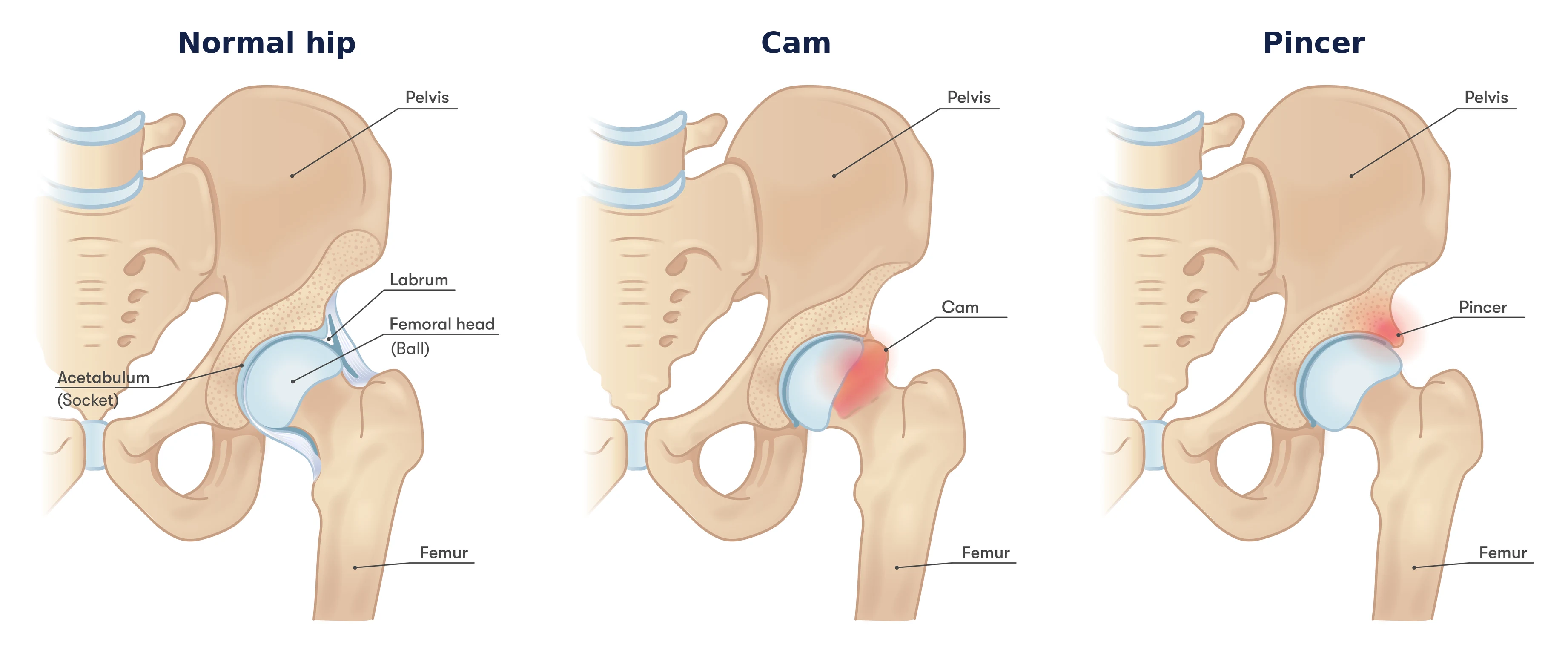
Inflammatory pain behaves differently. It appears after activity, at rest, or as morning stiffness, rather than in a specific position, and it persists. You feel it that evening or the next morning, and it can linger for days. Sometimes the inflammation is driven by mechanics; sometimes systemic inflammation in the background turns up the volume on the joint.
But here is the interesting part: these two patterns usually coexist. Mechanical irritation fuels inflammation, and an inflamed joint makes the mechanics feel worse. In my clinic, the question is rarely "which one is it?" It is "which one is driving, and which one is along for the ride?" That answer comes from your history and examination, not from a scan.
Labral tears are a dime a dozen. Depending on the age and activity level of the population you scan, many people, and in some groups most, have one. Something can be structurally abnormal yet symptomatically quiet, and that combination is common enough to be your starting assumption, not a surprising exception.
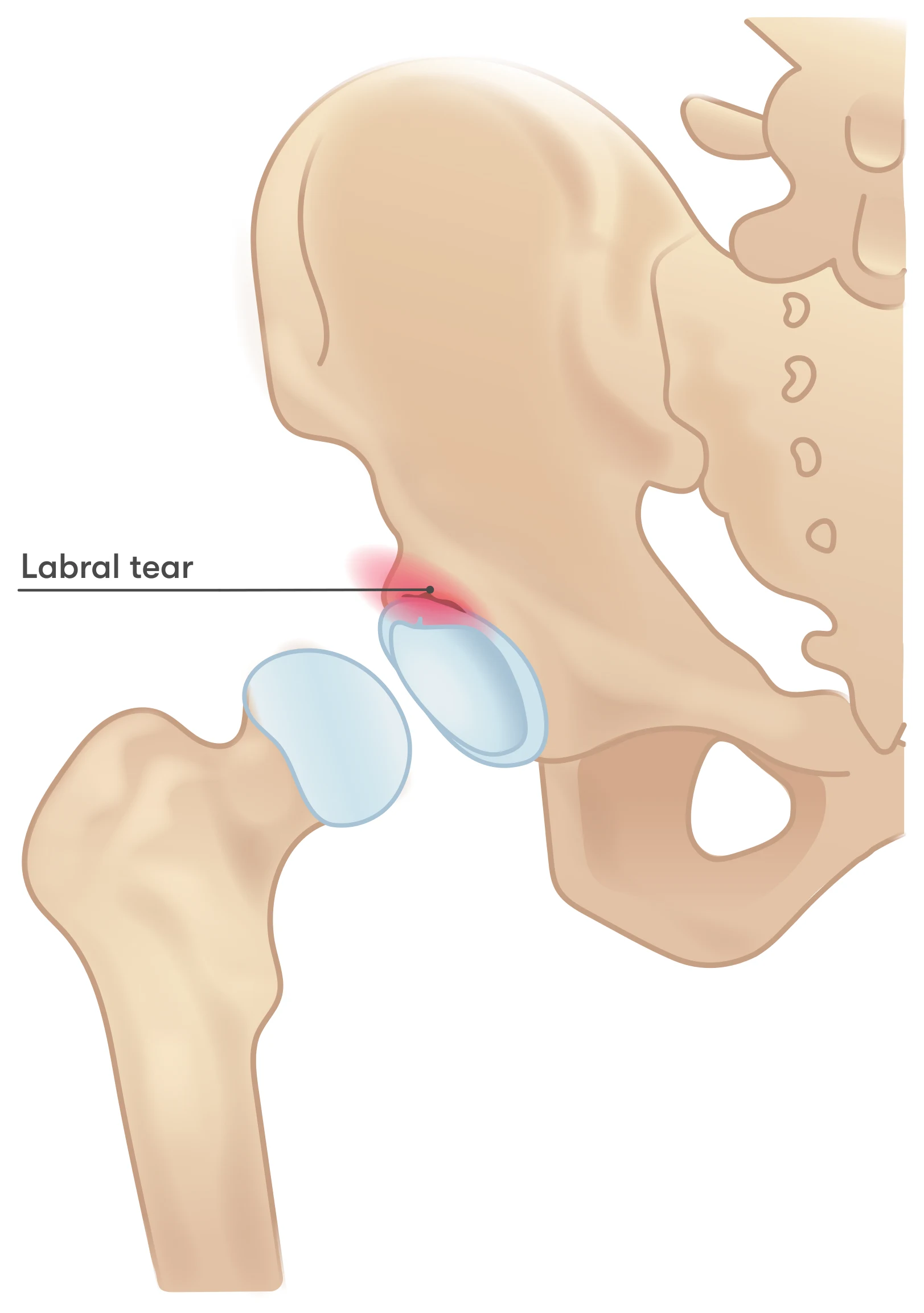
This is where medicine, my field included, gets it wrong more often than we would like to admit. A patient arrives holding an MRI report; the report says "labral tear," and the path of least resistance is to treat the report. But an MRI is a picture of your anatomy. It is not a picture of your pain or your function. Whether your labrum needs anything done to it depends on your examination, how you move, which positions provoke your symptoms, and how much all of this is disrupting the life you want to live. That is what dictates intervention, and intervention is a ladder, not a single rung: physical therapy, oral medications, topical medications, image-guided injections, biologics, and only then surgery. Sometimes, a combination of these options works better than any single one. Where you enter that ladder depends on where you are in the disease course and how loudly the problem is interfering with your quality of life.
If a physician recommends surgery primarily based on your MRI results, with little attention to how your body functions, that recommendation deserves a second look.
A labral tear is not the only source of pain in this part of the body. Deep gluteal syndrome, nerve entrapments such as pudendal neuralgia, pelvic floor dysfunction, short external rotator issues, ischiofemoral impingement, and pain referred from the lower back or sacroiliac joint, to name a few, can present as hip pain. Each deserves its own discussion, and this guide does not try to cover them. A thorough evaluation rules them in or out before anyone treats the MRI.
I want to be precise here because both the cynics and the true believers get this wrong.
At its core, physical therapy is structured exercise (or at least it should be) that insurance is willing to cover. I mean that as a compliment. Progressive, supervised loading is one of the most effective interventions we have for musculoskeletal problems, and for conditions caught earlier in their course, it can change the trajectory. Tendinopathy, an irritated and disorganized tendon, is the clearest example. Gluteal tendinopathy, the pain on the side of the hip that flares when you lie on it or climb stairs, responds particularly well to a properly dosed loading program. In a randomized trial, eight weeks of education plus exercise outperformed both a cortisone injection and a wait-and-see approach. At one year, more patients still rated themselves as improved, though pain was no longer different from the injection group [2].
Rehab also helps with structurally advanced hips, though to a more modest extent. If osteoarthritis is present, building strength in the muscles around the joint takes some load off the joint itself; evidence suggests the benefit is real but modest. If the socket is shallow and the joint is unstable, you can build resilience in the surrounding structures, so the joint is better supported and controlled.
But here is the honest boundary. Exercise cannot create mobility where bone is in the way, and it cannot create stability where the structure to provide it does not exist. You can't stretch bone. You can stretch muscle, and to a much lesser degree tendon and ligament, and even those do not respond to stretching nearly as well as people assume. If your impingement comes from a prominent cam lesion, which is extra bone along the ball of the hip joint, no amount of mobility work will remodel it. Rehab can change how the joint is loaded and how much irritation you experience. It cannot change the shape of the bone. Knowing which category your problem falls into is the difference between eighteen productive weeks of rehab and eighteen wasted months.
I did not arrive at my 2024 hip arthroscopy quickly, and I did not arrive at it because of my MRI results.
I have bilateral FAI. Over the years, I went through multiple full courses of physical therapy, oral medications, a cortisone injection, a Toradol injection, and PRP, not once but multiple times. I was not a passive patient hoping something would work; this is my field, and I applied it to myself as rigorously as I do to anyone in my clinic.
What ultimately tipped the decision was not a picture. It was mechanical symptoms: clicking, locking, catching, the joint sometimes getting stuck, a sense of instability, and a constant inflammatory cycle that never fully quieted down. It limited my ability to train and push, and more than that, it was starting to shrink my options—what I could do with my body and what I could enjoy doing. When a joint is mechanically misbehaving because of a structural cause that conservative care cannot reach, and you have given that conservative care a real, repeated trial, surgery stops being a failure of patience and becomes the logical next step.
Those are my surgical criteria, and there are three of them:
Notice what is not on that list: the MRI report alone. My MRI looked essentially the same in the years I was managing the hip without surgery as it did the month I decided to operate.
The randomized evidence points the same way [3]. In the UK FASHIoN trial of patients with FAI syndrome, hip arthroscopy improved hip-related quality of life more than personalized conservative care at one year, though the margin over good rehab was modest [4]. That is the finding to hold onto. Surgery wins on average by a little. In my experience, it wins by a lot for the right patient and not at all for the wrong one. Selection is everything.
The clearest example of the wrong patient: if arthritis is already established in the joint, evidence suggests arthroscopy does poorly, and the conversation shifts to other options.
Before you decide, you need a realistic picture of the other side, and that is the part of the conversation where American medicine is worst.
Our incentives reward a confident timeline. A surgeon who says "six months" books the case. A surgeon who says "a year, probably longer, and some things may not come all the way back" sounds like they lack confidence in their own hands. So patients are handed the best case, and then they measure themselves against it. When their tissue heals at the rate tissue heals, which is the only rate it knows, they conclude they are behind. They are not behind. The promise was ahead.
Two numbers matter more than the one you might be quoted. Return to play, meaning cleared to do the activity again, tends to arrive later than expected. Return to performance, meaning doing it at the level you did before, is an even smaller number. The two answer different questions. Across nearly two thousand hips, about 88% of athletes returned to sport after hip arthroscopy [5]. When one group of researchers asked the stricter question, back to the same sport at the same level, the number was 57%, and only 17% rated their performance as fully back almost three years out [6]. The gap between "back" and "back to normal" is where most of the disappointment lives. Ask your surgeon for both numbers and which one the timeline refers to.
Your life also sets the pace. Recovery runs on the same physiology that governs everything else, and if that physiology is already carrying a heavy load, healing is slower. The term for that load is allostatic load, coined by stress researchers Bruce McEwen and Eliot Stellar: the cumulative wear on the body from chronic stress, whether the stress is a job, a sick parent, a newborn, or sleep you haven't had in a year [7]. Evidence suggests psychological stress slows wound healing [8], and in my clinic, it slows rehab progression, too. If that is you, your timeline will likely be longer than the one on the handout. That is physiology, not failure.
Here is my number. My arthroscopy was in early 2024. It took me about two years to get back to where I expected to be. Two and a half years out, there are still things I cannot do. I knew the literature, had a rehab background, and did the work, and it still took that long. I'm not saying this to discourage anyone. I say it because nobody said it to me. Had I known beforehand, a lot of anxiety could likely have been avoided.
So measure against yourself: where you were last month, not where the person next to you at physical therapy is, and not where a timeline written before anyone had watched you heal says you should be. Measuring against others is the surest way to turn a good recovery into a bad experience.
There are no guarantees in medicine. With any intervention, from an injection to an arthroscopy, we cannot know with certainty whether an individual will come out better or worse. Before any procedure, what you want is a strong probability of coming out better and a clear accounting of what happens if you do not.
The way I structure that thinking with patients is by risk, upside, and time horizon.
Earlier in the disease course, an image-guided injection is often reasonable: with appropriate guidance and visualization, the acute risk is low, and the potential benefit is high. The long-term picture deserves honesty, too. Evidence links corticosteroid injections to faster arthritis progression in some patients, and in one randomized trial, repeated knee injections over two years caused more cartilage loss than saline [9–11]. So cortisone is a tool to use deliberately, not a subscription. My preference here is a strategic ketorolac (Toradol) injection instead, an off-label but increasingly studied use, particularly in the hip [12, 13]; one randomized trial found it comparable to cortisone for hip and knee arthritis pain [14].
Then there is the time horizon, which is the part almost nobody explains. A cortisone/Toradol injection tells you whether it worked within a week or two. In my practice, I give PRP and other biologics ten to fourteen weeks before judging whether they worked, and they carry a financial burden because they are rarely covered by insurance. Hip surgery moves you into a different category of time altogether: you are looking at close to a year, sometimes more for a complex case, before you truly know what you bought, and longer than that, as I learned, to get back everything you want. Every step up the ladder costs more time before the answer arrives, which is exactly why you want to be confident the step targets the real problem.
Before you book the surgery, ask three questions. Does your pain pattern and exam match the findings on your imaging? Has the appropriate conservative care, tailored to what your hip actually needs, been given a fair trial? And can you accept the time frame and the real odds of the next step, knowing there are no guarantees?
This is an investment, and you are making a well-informed guess. The quality of that guess depends on having a physician who treats you as an individual, not as part of a population: someone who looks at your hip, your movement, your life, and your goals, rather than applying an algorithm to a report.
This is exactly what my Comprehensive Consult ($750) is for. We review your imaging together, assess how your hip moves, map your symptoms to your anatomy, and walk through this framework as it applies to you, so whatever you decide, you do so with clear eyes. If surgery is the right call, you will go in confident. If it is not, you will know what to do instead.
Book a Comprehensive Consult →
Medicine Redefined, a two-part conversation with Alison Grimaldi, PhD. My co-host and I go deeper on the rehab side of everything above.
This guide is educational and does not constitute medical advice. Reading it does not create a doctor-patient relationship. Hip pain warrants an individualized evaluation, and I encourage you to get one before making any treatment decision.